Core Competencies

Most education consultancies stop at strategy. We design strategy and build the systems that make it work.

George Angus Consulting partners with education providers, industry bodies, governments, and global organisations across the full lifecycle of educational change: from initial research and policy development through to system design, implementation, and quality assurance. Our clients include national agencies, regional bodies, and global organisations across the private and public sectors, with projects spanning New Zealand, Australia, Asia, the Pacific, the Middle East, the UK, and the EU.

Our work is organised around seven interconnected areas of expertise. Each one represents a distinct capability. In practice, they rarely operate in isolation: a micro-credential project usually involves research, assessment design, and quality assurance; a digital credentialing system needs strategy, implementation, and independent verification. The value we bring is the ability to work across all of them, and to understand how decisions in one area affect outcomes in another.

Seven areas. One through-line: education systems that are credible, inclusive, and built to last.

For further information, contact us at stuart@georgeangusconsulting.com

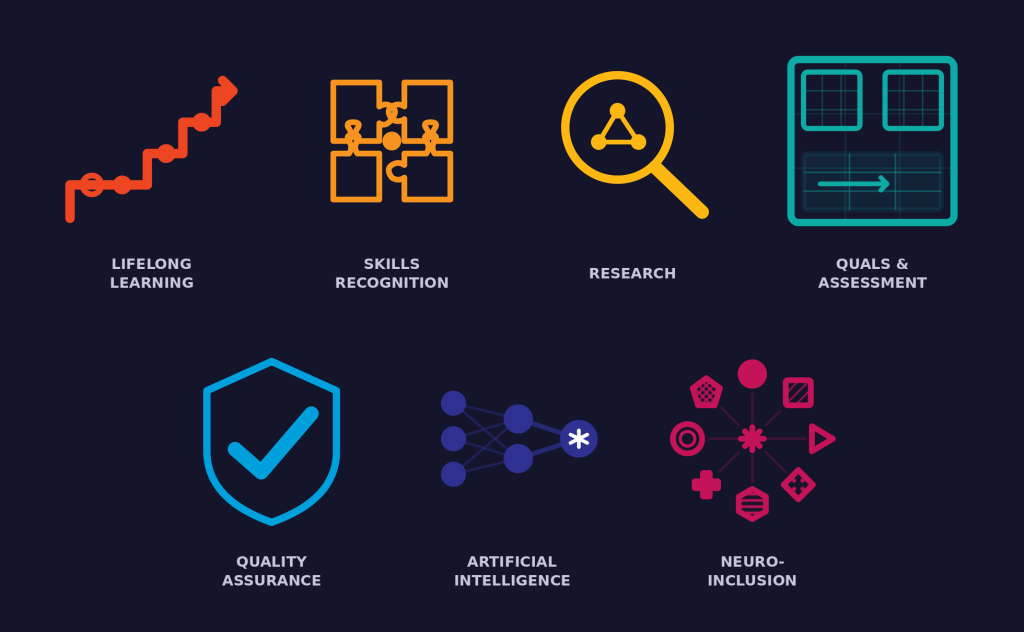
Each competency is represented by its own icon and colour, corresponding to one of the seven rays of light in the George Angus Consulting logo — each ray a distinct area of expertise, each one part of the same source of illumination.

Follow the links on our competencies listed below for further information.
Lifelong Learning

Developing strategy, and building and improving flexible, stackable learning systems that recognise and develop skills at every stage of a person’s working life: including micro-credentials, TVET transformation, and workforce development.

Skills Recognition

Too many people hold skills that go unrecognised. We help organisations make those skills visible, verifiable, and valued: through digital credentialing, recognition of prior learning, skills mapping, and the frameworks that hold those systems together.

Neuro-inclusion

Designing and improving education systems, training, assessments, workplaces, and policies that strengthen the experience and capabilities of neurodivergent learners and workers: so they’re genuinely supported and able to contribute to their fullest potential.

Research

Applied research that translates complex educational challenges into clear, actionable recommendations: spanning international comparative analysis, policy benchmarking, needs assessments, and mixed-methodology studies.

Qualifications & Assessment Design

Rigorous, fit-for-purpose qualifications and assessment design that accurately measures competence, maintains accessibility, and holds up in practice: from apprenticeships to micro-credentials, across local, national, regional, and global contexts in both regulated and non-regulated spaces.

Quality Assurance

Undertaking independent quality assurance reviews and building QA frameworks that go beyond compliance: creating systematic processes for continuous improvement across qualifications, assessments, and digital credentials.

Artificial Intelligence

Practical, evidence-grounded AI integration in educational contexts: including assessment design automation, ethical framework development, policy, and research into where AI genuinely improves outcomes and where it introduces risk.